
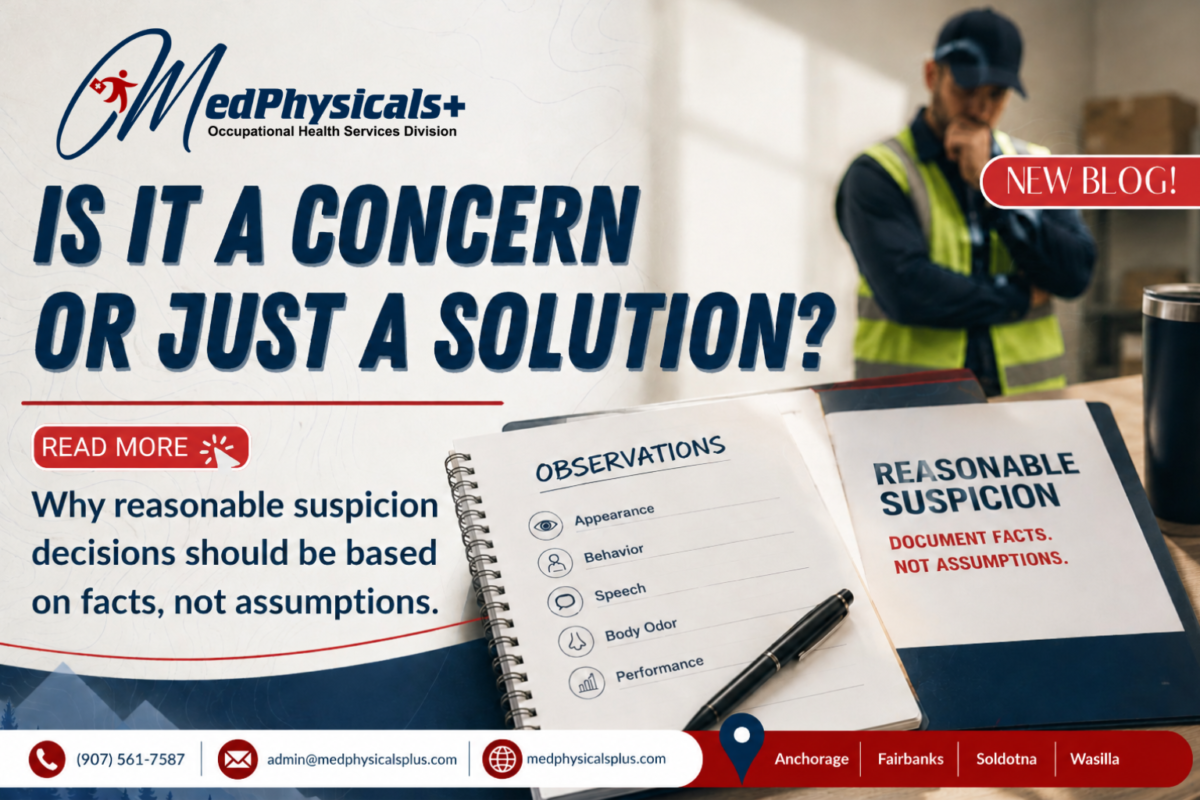
When an employee suddenly seems confused, unsteady, unusually agitated, or noticeably different from normal, a supervisor may wonder whether drugs or alcohol are involved. The difficult part is deciding what to do next without jumping to conclusions.
Reasonable suspicion testing should be based on observable facts, not rumors or assumptions. For employers, that means knowing what to look for, documenting what actually happened, and following the testing procedures that apply.
What Counts as Reasonable Suspicion?
Reasonable suspicion is more than a feeling that an employee may be impaired. Under Alaska law, workplace testing may be conducted for job-related purposes consistent with business necessity and the employer’s policy, including reasonable suspicion that drug or alcohol use may adversely affect job performance or the work environment.
For FMCSA-regulated commercial drivers, the standard is more specific. Reasonable suspicion must be based on specific, current observations involving the driver’s appearance, behavior, speech, or body odor. A hunch by itself is not enough.
What Should Supervisors Look For?
Changes in speech, coordination, behavior, concentration, or work performance may raise concerns, but no single sign automatically proves drug or alcohol use. An employee may behave differently for many reasons, which is why supervisors should not try to diagnose the cause.
Instead, focus on what can actually be observed. For FMCSA-covered drivers, the regulations focus on specific observations involving appearance, behavior, speech, or body odor, while supervisor training addresses physical, behavioral, speech, and performance indicators that may support a reasonable suspicion determination.
Document the Behavior, Not the Conclusion
Writing “the employee was high” is a conclusion. Writing “the employee’s speech was noticeably slurred and they repeatedly lost their balance while standing” documents what the supervisor actually witnessed.
Good documentation should explain what happened, when it happened, and what was personally observed. For FMCSA-covered drivers, federal rules require reasonable suspicion determinations to be based on specific, contemporaneous, articulable observations.
Supervisor Training Matters
Supervisors should understand this process before an incident happens. Training helps them recognize possible indicators while avoiding decisions based on rumors, assumptions, or one unexplained change in behavior.
Under Alaska’s statutory testing framework, at least one designated employee must receive 60 minutes of training on alcohol misuse and another 60 minutes on controlled substance use. FMCSA has a similar training requirement for supervisors responsible for reasonable suspicion determinations involving covered CDL drivers.
What Should Employers Do Next?
When a concern arises, employers should follow their written drug and alcohol testing policy and the state or federal requirements that apply. Document the observations promptly, follow the established internal process, and coordinate testing when the applicable standard has been met.
DOT and non-DOT testing should also remain separate. A company’s workplace policy may allow testing in circumstances that do not qualify as a federally required DOT test. For FMCSA-covered drivers, employers need to follow the applicable federal reasonable suspicion requirements.
Reasonable Suspicion Testing in Alaska
Employers should not wait until a workplace incident to figure out who makes the decision, what needs to be documented, or where an employee should be sent. A clear process helps supervisors respond consistently without making unsupported accusations.
MedPhysicals Plus works with employers that need reasonable suspicion testing in Alaska, drug and alcohol testing, and other occupational health services in Alaska. We serve employers in Anchorage, Fairbanks, Wasilla, or Soldotna. To learn more or coordinate testing, contact us at (907) 561-7587, email admin@medphysicalsplus.com, or visit medphysicalsplus.com.