
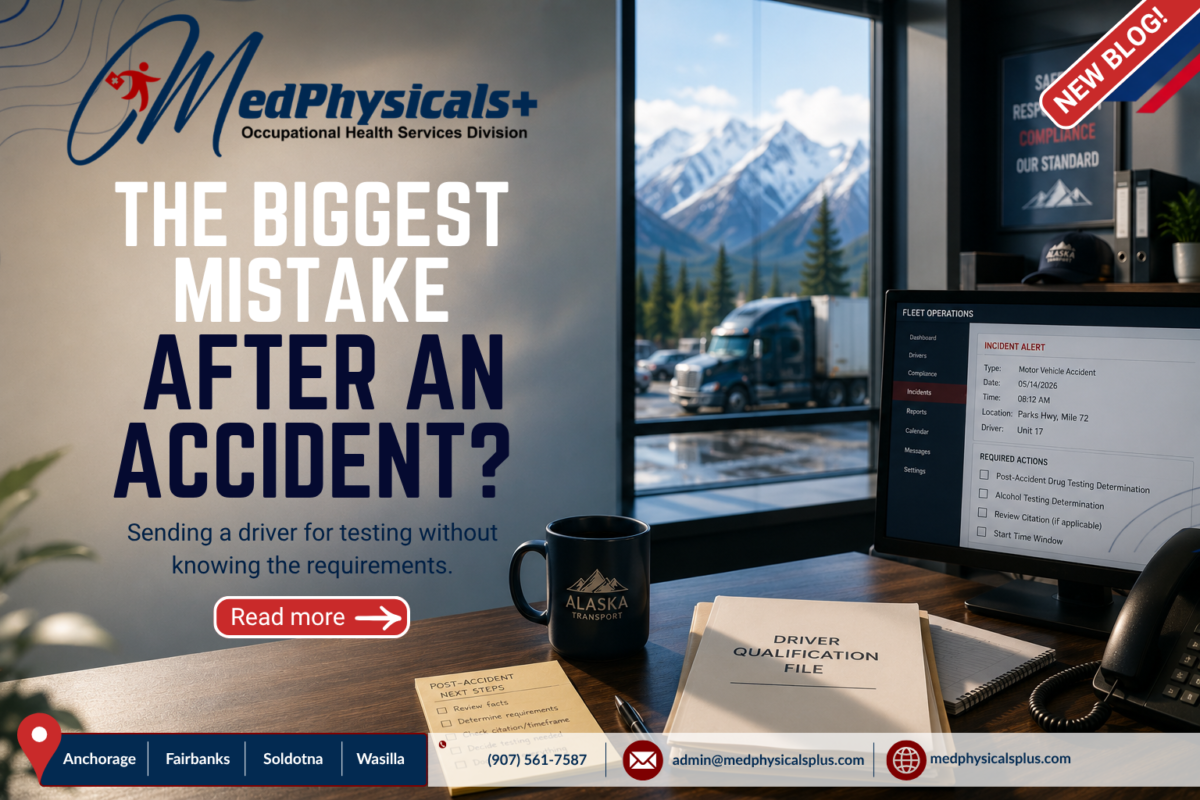
When a commercial driver is involved in an accident, employers may assume a DOT drug and alcohol test needs to happen right away. But not every accident requires one. Under FMCSA rules, specific circumstances determine when post-accident testing is required.
Before sending a driver for post-accident drug testing in Alaska, employers should first confirm that the driver is subject to FMCSA testing requirements and determine what actually happened in the accident.
When Is DOT Post-Accident Testing Required?
FMCSA’s post-accident testing requirements look at whether the accident involved a human fatality, bodily injury requiring immediate medical treatment away from the scene, or disabling damage to a motor vehicle requiring it to be transported away from the scene.
For an accident that meets FMCSA’s post-accident testing requirements and involves a human fatality, drug and alcohol testing is required regardless of whether the CMV driver receives a citation. For qualifying nonfatal injury or tow-away accidents, the citation also matters. The driver must receive a citation for a moving traffic violation arising from the accident within 8 hours for alcohol testing or within 32 hours for drug testing.
If the driver does not receive the qualifying citation within the applicable period, FMCSA’s post-accident testing requirement is not triggered for those nonfatal categories. An employer may have a separate company testing policy, but that should not automatically be treated as a federally required DOT test.
If Testing Is Required, Timing Matters
Once an employer determines that DOT post-accident testing is required, testing should be completed as soon as practicable. For alcohol testing, if the test is not administered within 2 hours, the employer must document why and continue attempts for up to 8 hours.
For controlled substances testing, attempts can continue for up to 32 hours. If the required test cannot be completed within the applicable period, the employer must stop attempts and document why it was not administered.
What Employers Should Verify Before Sending a Driver
Before ordering a DOT post-accident test, employers should confirm:
- Is the employee subject to FMCSA drug and alcohol testing requirements?
- Did the accident involve a human fatality?
- Did someone immediately receive medical treatment away from the scene?
- Did a vehicle sustain disabling damage requiring it to be transported away?
- For a qualifying nonfatal accident, did the driver receive a moving-violation citation within the applicable time period?
Having these answers can help employers determine whether they are dealing with a federally required DOT test or testing required under a separate company policy.
Have a Post-Accident Testing Process Before You Need One
The middle of an accident response is not the best time to figure out what kind of testing is required. Employers with DOT-regulated drivers should have a clear process for gathering accident information, determining whether testing is required, and getting the employee tested within the federal time limits.
MedPhysicals Plus helps Alaska employers manage post-accident drug and alcohol testing and workplace drug testing needs. We work with employers across Alaska, with locations in Anchorage, Fairbanks, Wasilla, or Soldotna. To learn more about employer drug testing services, contact MedPhysicals Plus at admin@medphysicalsplus.com, call (907) 561-7587, or visit medphysicalsplus.com.